 English
 简体中文
简体中文 italiano
 Español
 Deutsch
 português
 한국어
한국어 日本語
日本語 Français
 Русский язык
  Україна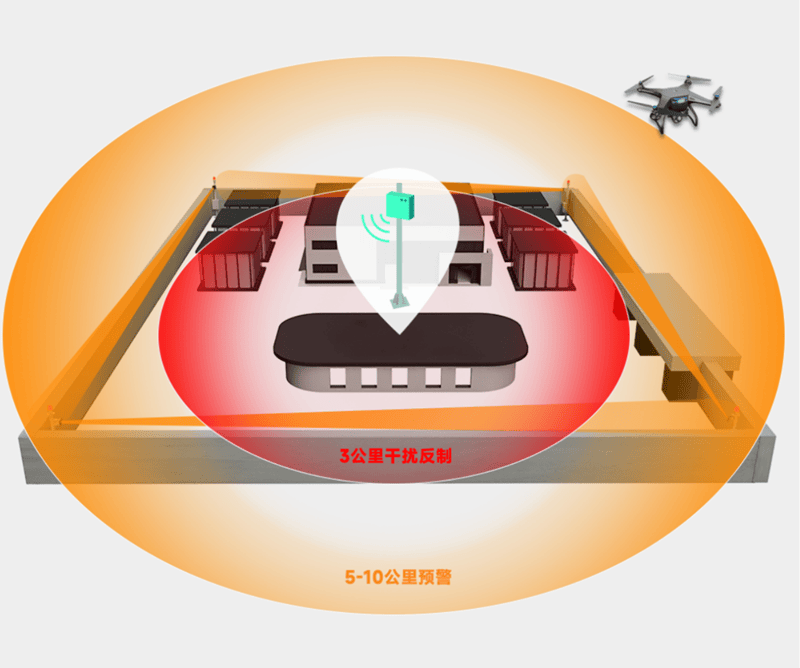
Key areas Counter Drone Solutions


Key Areas Counter Drone Solutions
1. Overview
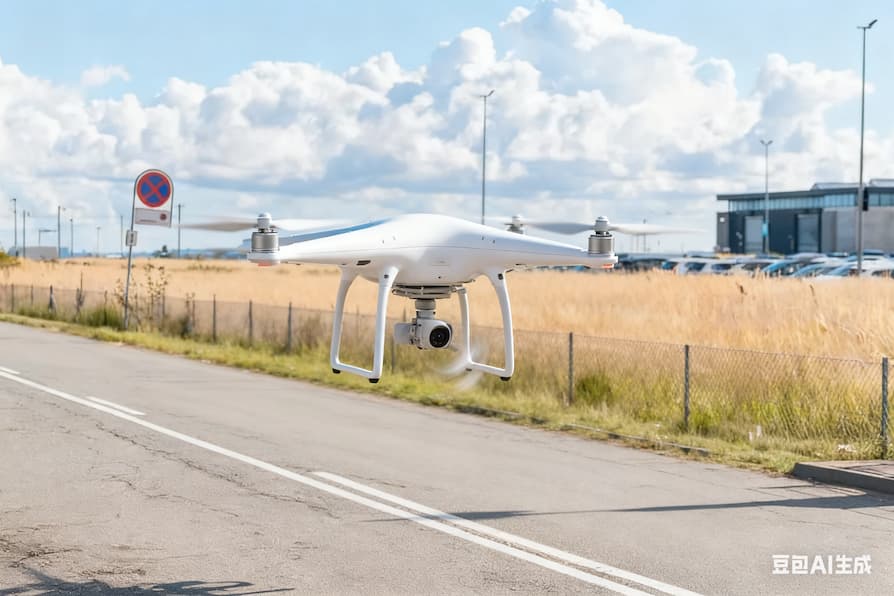
Due to their diverse functions and high cost-effectiveness, drones have seen a sharp increase in applications in both military and civilian fields in recent years. The changes in military strategies and tactics caused by the mixed use of military and civilian drones have attracted widespread attention from military forces around the world. With the continuous reduction of production costs, drones have become more accessible to different actors. The technical capabilities of drones have been maliciously or illegally used in civilian fields. These maliciously used drones may be modified versions of commercial models or models intentionally designed for illegal purposes. Some potential malicious activities involving these drones include surveillance and privacy violations, security threats, harassment and sabotage, transportation of illegal and harmful items, and weapons.
In the civilian field, the development of unmanned aerial vehicles has promoted the development of low-altitude economy. At the same time, it has also brought new problems. In recent years, accidents caused by illegal drone flights have been frequent. Criminals use drones for peeping, illegal shooting of major events, illegal manipulation of drones to damage infrastructure, such as high-voltage power lines causing regional power outages, forcing light rail trains to stop, interfering with aviation order, and even using drones to transport drugs and smuggle across borders, which seriously threaten social public safety.
In the military field, with the gradual large-scale application of drones in military operations, the development of anti-drone equipment has become a necessary path to win modern unmanned wars. In the context of current great-power competition and game, the probability of local conflicts is increasing, which also leads to complex forms, appearances, and combat modes of modern wars. Unmanned aerial vehicles, which are easy to deploy, simple to use, and have high operational cost-effectiveness, are used more and more frequently in terrorist attacks, armed conflicts, and other fields. The US Army lists drones as one of the "five major threat platforms" (fixed-wing aircraft, drones, ballistic missiles, cruise missiles, and helicopters), and considers drones to be one of the most destructive air threats, believing that drones will pose a threat to the entire combat process.
Curbing the potential threats posed by unmanned aerial vehicles has become an urgent problem to be solved.
2. Current Situation and Demand Analysis
Threat Background
(1) Reconnaissance and Positioning Threats
Most current drones are equipped with high-definition cameras, and higher-level drones are even equipped with multispectral sensors, infrared thermal imaging, and other equipment, which can conduct high-definition low-altitude reconnaissance of activity sites to understand the overall activity layout and security deployment.
(2) Terrorist Attack Threats
Drones and FPV racing drones can carry C4 explosives or high-explosive bombs to attack activity sites at ultra-high speeds.
counter drone solution Capability Needs
(1) Requirements for Situational Awareness Capability
· Full-domain low-altitude detection capability;
· Coverage of frequency bands commonly used by unmanned aerial vehicles (including mainstream and self-made drones), such as 2.4GHz, 5.8GHz, and satellite navigation bands, to ensure effective detection of various types of unmanned aerial vehicles, which should be timely detected when entering the early warning area (centered on the activity site with a radius of 3-5 kilometers or more);
· Support for 7×24-hour unattended operation to achieve all-weather, all-day, and full-range prevention and control;
· Flexible operation mode settings (manual/auto disposal as needed);
· Simultaneous monitoring of multiple drone targets;
· Multi-element integrated anti-invasion capability. The system platform should integrate low-altitude radar, optoelectronic turntables, radio frequency detection equipment, etc., to form multi-dimensional coverage.
(2) Requirements for Interference and Interception Capability
· Effective interference with and disposal of "illegal unmanned aerial vehicles" (e.g., ordinary drones, FPV racing drones);
· Capability to defend against swarm saturation attacks;
· Interference and defense range of 2-3 kilometers.
Escort convoy counter drone solution
(1) Reconnaissance Threats
Drones can continuously monitor the travel route and situation of VIP convoys. Terrorists can use real-time drone video transmission and coordinate positioning to attack convoys.
(2) Strike Threats
Drones and FPV racing drones can carry C4 explosives or high-explosive bombs to attack VIP convoys at ultra-high speeds, causing heavy damage.
Capability Needs
(1) Requirements for Situational Awareness Capability
· Full-domain low-altitude detection capability;
· Coverage of frequency bands commonly used by unmanned aerial vehicles (including mainstream and self-made drones), such as 2.4GHz, 5.8GHz, and satellite navigation bands, to ensure effective detection of various types of unmanned aerial vehicles, which should be timely detected when entering the early warning area (centered on the convoy with a radius of 2-3 kilometers);
· FPV racing drone analog video transmission interception function;
· Support for 7×24-hour unattended operation to achieve all-weather, all-day, and full-range prevention and control;
· Flexible operation mode settings (manual/auto disposal as needed);
· Simultaneous monitoring of multiple drone targets;
(2) Requirements for drone Interference and Interception Capability
· Effective interference with and disposal of "illegal unmanned aerial vehicles" (e.g., ordinary drones, FPV racing drones);
· Capability to defend against swarm saturation attacks;
· Interference and defense range of 2-3 kilometers.
3. System Design
The system is divided into a drone detection and defense system for activity sites and a drone detection and defense system for VIP convoys.
Drone detection and defense system in activity site
Anti Drone System Composition
The drone detection and defense system for activity sites consists of a drone detection and countermeasure system, a command and control system, and a portable drone detection and countermeasure shield.
Anti Drone System Topology Diagram
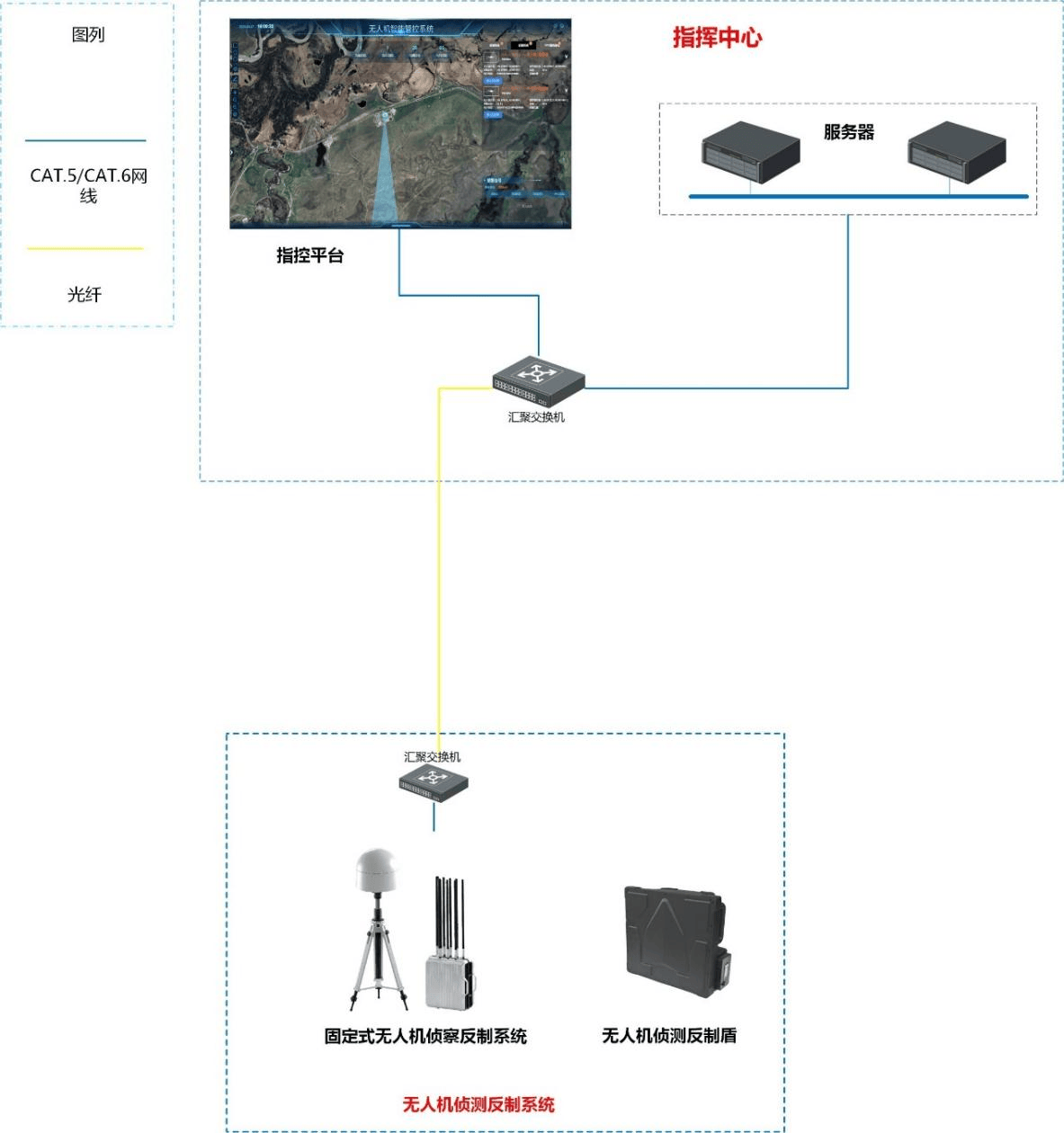
Drone Intelligent Management and Control System
Figure Legend
Command Center
Server
CAT.5/CAT.6 Network Cable
Command and Control Platform
Optical Fiber
Aggregation Switch
Aggregation Switch
Fixed-Type Drone Reconnaissance and Countermeasure System
Drone Detection and Countermeasure Shield
Drone Detection and Countermeasure System
Deployment Instructions
The system uses cognitive radio protocol cracking technology, applying advanced radio reverse engineering and security analysis to drone detection and defense, achieving "three noes and two accuracies": passive detection, unattended operation, 360° no dead angles, precise strikes, and accurate direction finding. The main targets are low-flying conventional drones, FPV drones, and other air targets.
Taking the airspace of activity sites as the core protection area against drone invasion, it forms a drone detection and defense system capable of identification, early warning, positioning, interference, and countermeasures, achieving full-domain detection, early warning, interference, and countermeasures against illegal drones.
Deploying 1 drone detection and countermeasure device at the commanding height forms a drone early warning and defense circle covering 360° horizontally and 5-10 kilometers in depth.
Portable drone detection and countermeasure equipment is simultaneously deployed around the activity site to compensate for regional defense blind spots.
(3 km interference and countermeasure
5-10 km early warning)
System Functions
a) Passive Detection: The system only passively receives electromagnetic signals without transmitting any, with no impact on the surrounding electromagnetic environment;
b) Unattended Operation: The system works continuously for 24 hours, automatically classifying and identifying detected drone targets and issuing threat warnings without manual intervention;
c) Accurate Identification: It distinguishes drones of the same brand, model, and different IDs in the feature library and identifies multiple drones on the same frequency band;
d) Intelligent Early Warning: It automatically distinguishes between cooperative and non-cooperative drone targets, intelligently identifies inspection drones, and warns of foreign invading drones, with complete log recording;
e) Full Model Library: It identifies mainstream consumer drone brands/models and records electronic fingerprint IDs, covering 100+ models;
f) Full Interference and Countermeasure Frequency Bands: 8 common bands covering 400MHz–5.8GHz, the common frequency domain for drones.
3.2 UAV detection and defense system for VIP motorcade
Anti drone System Composition
The drone detection and defense system for VIP convoys consists of a vehicle-mounted drone reconnaissance and countermeasure system, a command and control system, and a portable drone detection and countermeasure device.
Anti drone System Topology Diagram
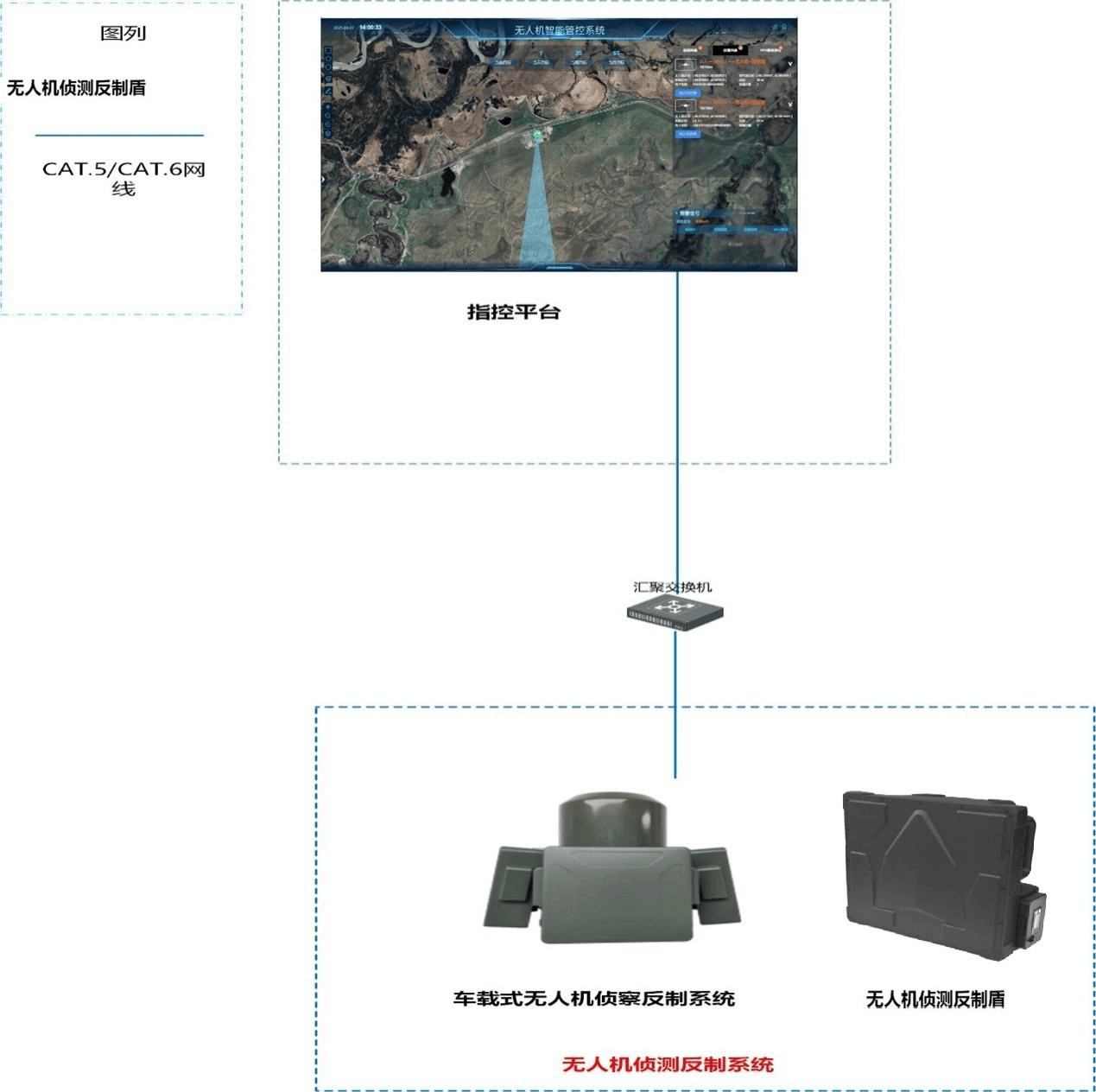
Drone Intelligent Management and Control System
Drone Detection and Countermeasure Shield
CAT.5/CAT.6 Network Cable
Command and Control Platform
Aggregation Switch
Vehicle-Mounted Drone Reconnaissance and Countermeasure System
Drone Detection and Countermeasure Shield
Drone Detection and Countermeasure System)
3.2.3 Deployment Instructions
Taking VIP convoys as an example, the equipment is deployed in the middle vehicle, forming a mobile core protection area against drone invasion centered on the vehicle, covering 360° horizontally and 2-3 kilometers in depth, with capabilities for drone identification, early warning, positioning, interference, and countermeasures to achieve full-domain detection, early warning, interference, and countermeasures against illegal drones.
Portable drone detection and countermeasure equipment are simultaneously deployed on the lead and tail vehicles of the convoy to compensate for regional defense blind spots.
3.2.4 System Functions
a) Passive Detection: The system operates by only passively receiving electromagnetic signals without transmission, with no impact on the surrounding electromagnetic environment;
b) Unattended Operation: The system works continuously for 24 hours, automatically classifying and identifying detected drone targets and issuing threat warnings without manual intervention;
c) Accurate Identification: It distinguishes drones of the same brand, model, and different IDs in the feature library and identifies multiple drones on the same frequency band;
d) Intelligent Early Warning: It automatically distinguishes between cooperative and non-cooperative drone targets, intelligently identifies inspection drones, and warns of foreign invading drones, with complete log recording;
e) Full Model Library: It identifies mainstream consumer drone brands/models and records electronic fingerprint IDs, covering 100+ models;
3.3 System Advantages
"Comprehensive Monitoring" – Full-domain situational awareness covering low altitude;
"Effective Interception" – Multi-frequency band coverage, capable of countering swarms and FPV attacks;
4. Introduction to Anti Drone System Equipment
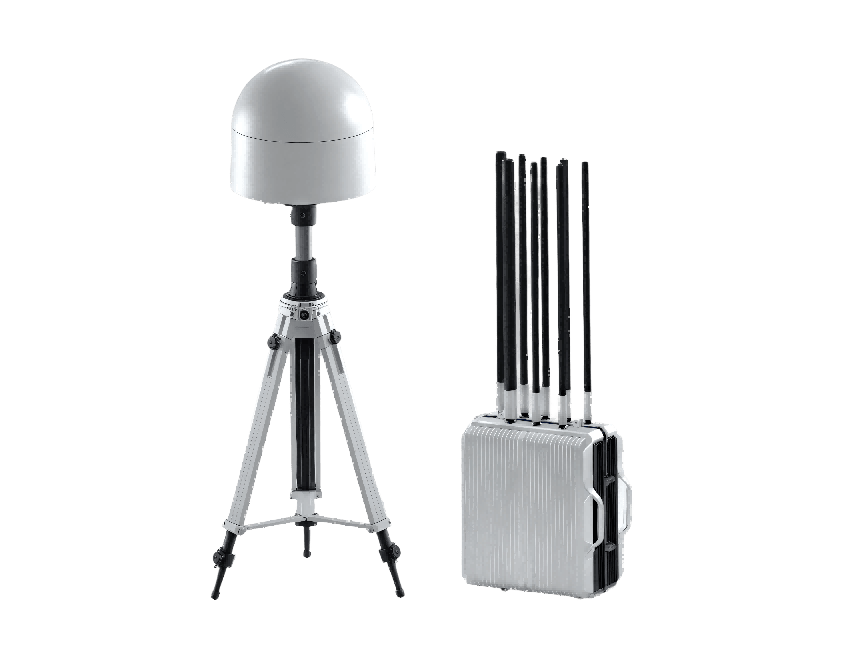
4.1 Drone Detection and Countermeasure Equipment DR200-ABC
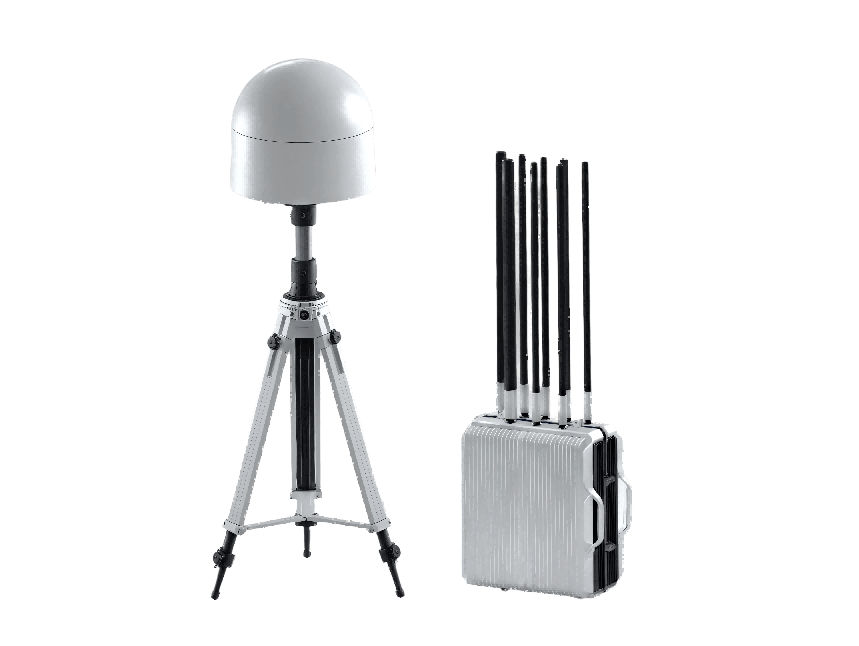
4.1.1 System Functions
The drone detection and defense equipment comprises a drone detection system, radio frequency interference system, and navigation decoy system, capable of detecting, identifying, interfering with, countering, and decoying drones. It can make drones hover in place, land, or return, effectively protecting low-altitude airspace safety and preventing drones from entering the defense zone. It features excellent detection and defense performance, long-distance operation, unattended operation, and automatic drone detection and defense.
4.1.2 Advantages and Characteristics
4.1.2.1 Wide Detection Frequency Band
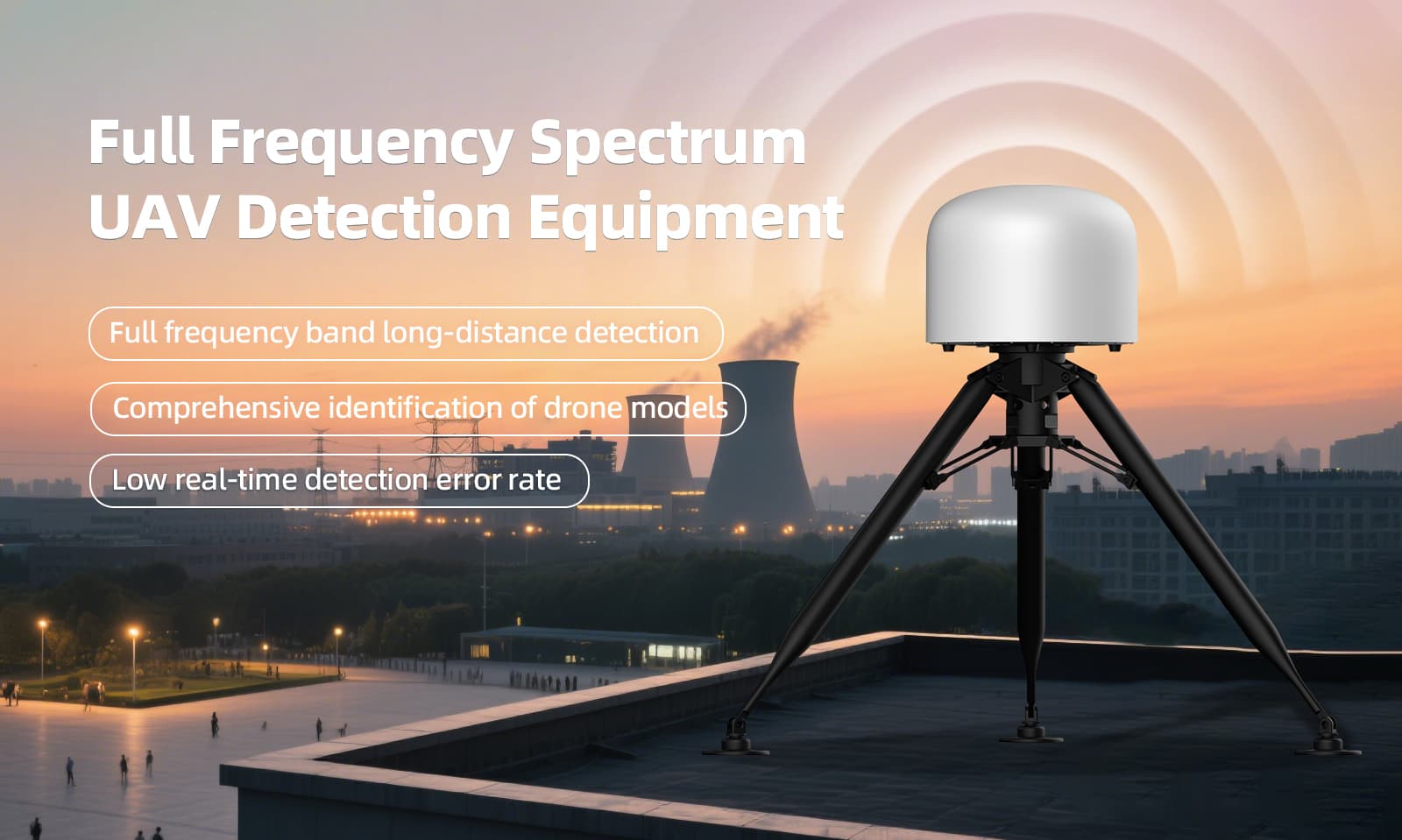
70MHz–6GHz full-frequency band detection and coverage, with a comprehensive drone model library. Narrowband extraction based on radio protocol cracking technology accurately separates signals of any bandwidth and sampling rate, identifying different frequency points, bandwidths, and protocols in sampled signals. Through reverse engineering, corresponding communication protocols are obtained to derive communication IDs of drones and remote controllers, determine timing carrier frequencies, and accurately distinguish different drones of the same manufacturer, brand, and model.
4.1.2.2 Passive Detection
After activation, the system continuously and passively detects radio signals (drone telemetry, control, and video transmission signals) in the defense area 24/7 via an omnidirectional antenna without personnel attendance.
4.1.2.3 Analog Video Transmission Interception Capability
It intercepts analog video transmission to view "first-person view" (FPV) for analyzing intrusion targets and real-time dynamics.
4.1.2.4 Full Interference and Countermeasure Frequency Bands
Full coverage of interference and countermeasure bands: 8 common bands covering 400MHz–5.8GHz, the common frequency domain for drones.
4.1.2.5 Multi-Element Integrated Air Defense Capability
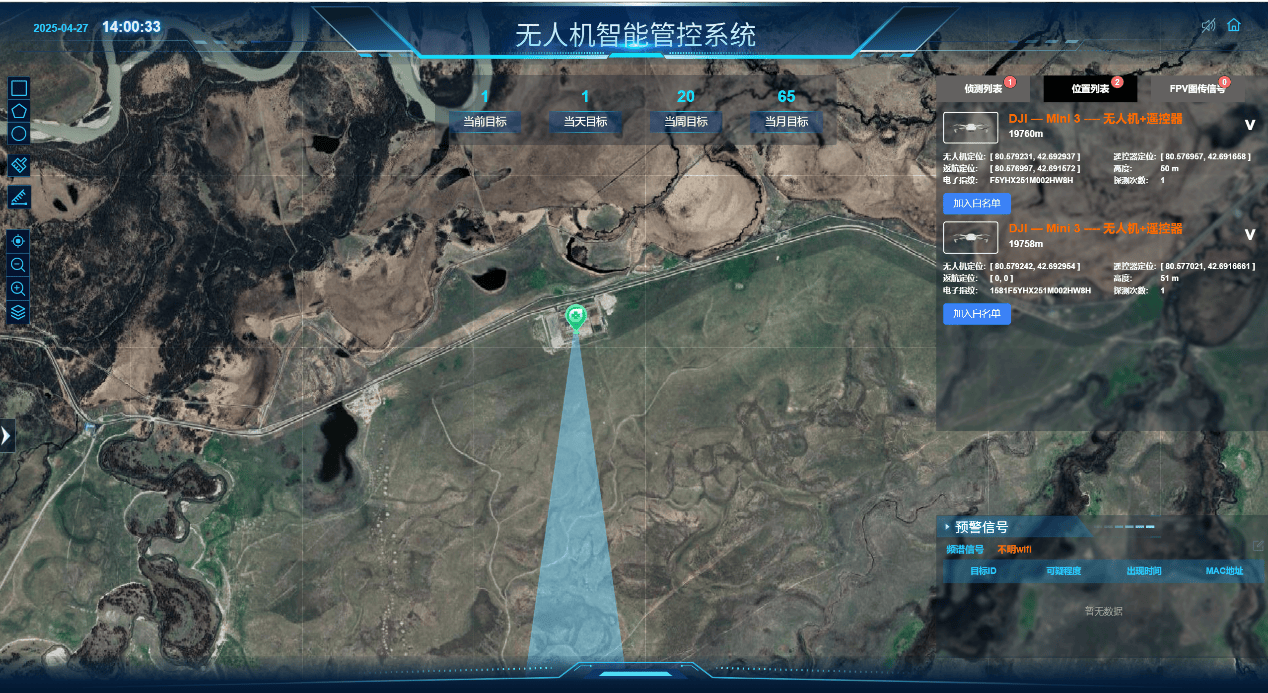
Through the drone intelligent management and control system, it integrates radio frequency spectrum, radar, optoelectronic, and navigation decoy equipment to achieve multi-element air-ground anti-invasion capability. External devices like radar, optoelectronic sights, and navigation decoys significantly enhance the air defense system's comprehensive effectiveness. Multi-sensor fusion improves target detection/identification accuracy and system flexibility, effectively countering diverse drone air threats.
4.1.3 Technical Indicators
1 | Detection Frequency Band | 70MHz–6GHz full-frequency band scanning, detection, and display |
2 | Key Detection Frequency Bands | 800MHz, 900MHz, 1.2GHz, 1.4GHz, 1.5GHz, 2.4GHz, 5.2GHz, 5.8GHz |
3 | Detection Distance | ≥10km (subject to working conditions) |
4 | FPV Video Transmission Detection | ≥2km |
5 | Analog Video Transmission Interception | Viewable analog video |
6 | Detection Range | Horizontal: 360° |
7 | Detection Response Time | ≤10s from drone power-on to device detection and reporting |
8 | Direction Finding Accuracy | ≤±3° (RMS, in unobstructed areas with no significant electromagnetic interference) |
9 | Detection Display | Drone distance, flight height, speed, position (latitude/longitude, precise to 1m), model, SN, takeoff point, return point, real-time trajectory, etc. |
10 | Interference Distance | ≥3km (subject to working conditions) |
11 | Interference Azimuth Coverage | 360° horizontal |
12 | Interference Frequency Bands | Fixed bands: |
13 | Interference Response Time | ≤7s |
14 | Decoy Signal | GPS, GLONASS, BeiDou |
15 | Decoy Radius | 1~3km+ (varies by environment and model) |
16 | Strategy Support | Directional dispelling, regional denial, spatial deception, temporal-spatial deception |
17 | Decoy Activation Time | ≤4S |
18 | Cloud Platform | (1) Unattended and manual control; automatic drone discovery, identification, alarm, positioning, and disposal. Software auto-starts interference equipment for full-automatic tracking suppression based on monitoring data. |
19 | Environmental Adaptability | Operating temperature: -40℃~60℃ |
4.2 Portable Drone Detection and Countermeasure Equipment DR300-1
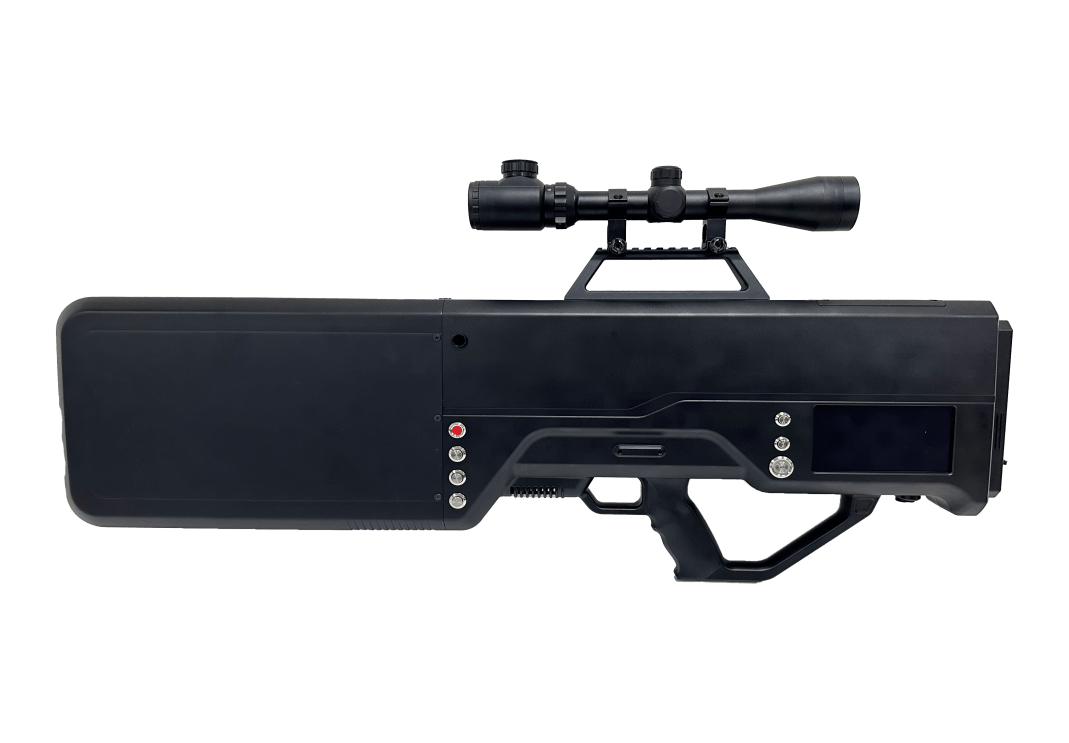
4.2.1 System Functions
The equipment detects illegal drone intrusions via radio frequency scanning, feature recognition, and decoding, intercepting control and video transmission signals between drones and remote controllers. Through electromagnetic suppression, it disrupts drone remote control, video transmission, and navigation links, forcing drones to return or land.
4.2.2 Advantages and Characteristics
4.2.2.1 Full Detection Frequency Band
400MHz–6GHz key band detection, covering mainstream models.
4.2.2.2 Multiple Interference Bands and Strong Capability
Breaking through traditional VOC frequency scanning, it uses the latest DDS core algorithm for strong interference against frequency-modulated spread spectrum and FPV drones; covers 7 common bands + 3 optional extended bands across 400MHz–5.8GHz.
4.2.3 Technical Indicators
Detection Frequency Band | 400MHz–1500MHz, 2200–2500MHz/5150–5950MHz (DJI, Autel, and some WIFI models) |
Detection Distance | ≥2km (subject to working conditions and model) |
Countermeasure Distance | ≥2km (subject to working conditions and model) |
Countermeasure Frequency Bands | 800MHz, 900MHz, 1.2GHz, 1.4GHz, 1.5GHz, 2.4GHz, 5.2GHz, 5.8GHz |
Channel Power | 1555~1650MHz |
Interception Channels | 8 channels |
Countermeasure Azimuth Coverage | ≥30° |
Display Screen Size | ≥4.7 inches, displaying ≥10 drone detection results simultaneously |
Status Indication | Shows detected drone brand, frequency band, signal strength, and 4G signal strength |
Direction Finding | Capable of direction finding for selected drone targets, real-time displaying signal strength |
Detection Angle | 0°~360° horizontal coverage |
Interference-to-Communication Ratio | ≥20:1 |
Alarm Prompt | Audible alarm upon drone detection |
Interference Function | Emits wireless signals to make drones hover, return, or land |
Frequency Band Switching | Selectable single communication interference, single navigation interference, or full-band interference |
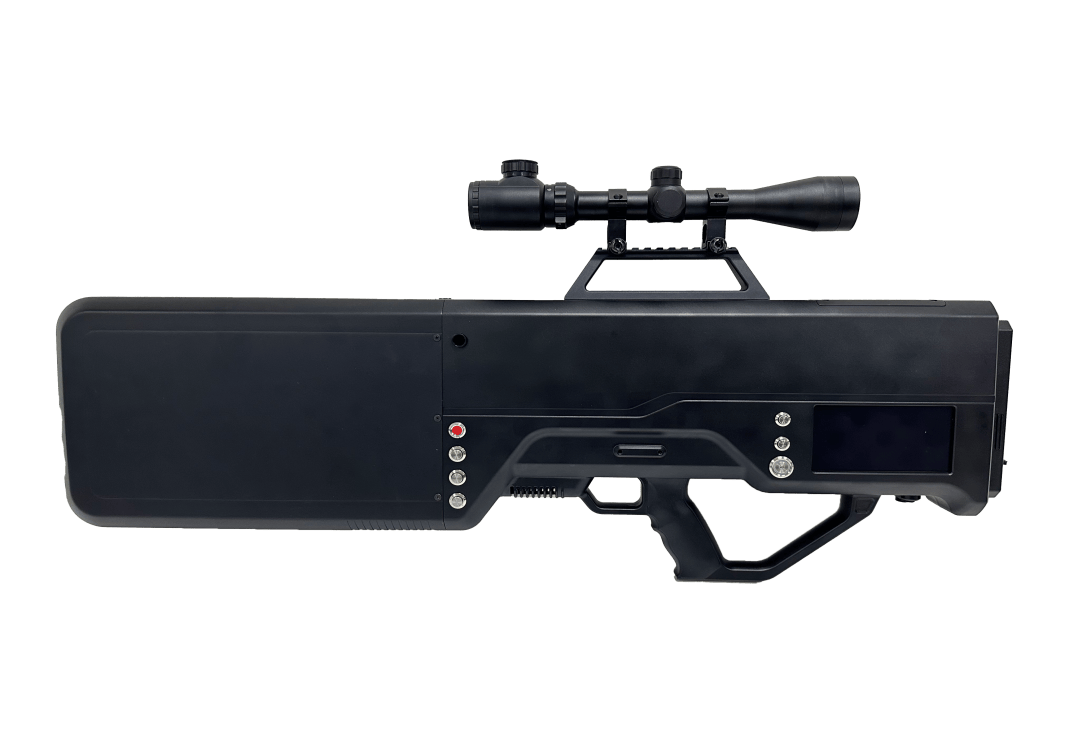
4.3 Portable (Shield-Type) Drone Detection and Anti Drone Device DR500-AB
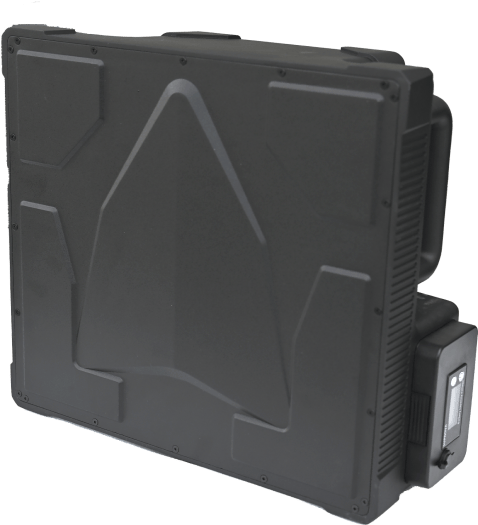
4.3.1 System Functions
The portable (shield-type) drone detection and defense equipment consists of a drone detection system and radio frequency interference system, featuring excellent detection/defense performance and long-distance operation. By suppressing drone remote control data transmission, video transmission, and navigation signals, it forces drones to hover, land, or return, protecting low-altitude airspace safety.
4.3.2 Advantages and Characteristics
4.3.2.1 Wide Detection Frequency Band
400MHz–6GHz key band detection, covering mainstream models and effectively identifying FPV racing drones.
4.3.2.2 Full Interference and Countermeasure Frequency Bands
6 common bands covering 900MHz–5.8GHz, the common frequency domain for drones.
4.3.2.3 Strong Battery Life
Dual-battery design with 20-hour detection standby time.
4.3.3 Technical Indicators
Detection Frequency Band | 400MHz–1500MHz, 2200–2500MHz/5150–5950MHz (DJI, Autel, and some WIFI models) |
Detection Distance | ≥2km (subject to model) |
Countermeasure Distance | ≥2km (subject to model) |
Countermeasure Frequency Bands | 900MHz, 1.2GHz, 1.5GHz, 2.4GHz, 5.2GHz, 5.8GHz |
Channel Power | 1555~1650MHz 20W |
Interception Channels | 6 channels |
Countermeasure Azimuth Coverage | ≥30° |
Display Screen Size | ≥3.5 inches, showing drone signal strength and frequency band |
Status Indication | Displays detected drone frequency band and signal strength |
Direction Finding Accuracy | ≤10° |
Detection Angle | 0°~360° horizontal coverage |
Interference-to-Communication Ratio | ≥20:1 |
Alarm Prompt | Audible alarm upon drone detection |
Interference Function | Emits wireless signals to make drones hover, return, or land |
Frequency Band Switching | Selectable single communication interference, single navigation interference, or full-band interference |
Interference Coverage Angle | Horizontal ≥45°, vertical ≥30° |
Networked Supervision | Optional multi-level interconnection with mobile APP and backend command platforms |
Working Temperature | -40℃–60℃ |
Product Weight | 8Kg (including battery) |
Standby Time | ≥20h (with detection and alarm during standby) |
Working Time | ≥30min |
4.4 Drone Detection and Countermeasure Equipment DR100-AB
4.4.1 System Functions
The vehicle-mounted drone detection and countermeasure integrated system is a comprehensive security solution integrating detection, identification, and countermeasure functions, designed to address complex drone threats. It real-time monitors drone activities, identifies types and trajectories, and employs multiple countermeasures to curb illegal intrusions or malicious activities.
4.4.2 Advantages and Characteristics
4.4.2.1 Wide Detection Frequency Band
300MHz–6GHz full-frequency band coverage with a comprehensive drone model library. Narrowband extraction via radio protocol cracking accurately separates signals, identifies protocols, and distinguishes different drones of the same model through reverse engineering.
4.4.2.2 Passive Detection
24/7 passive detection of radio signals (telemetry, video transmission, navigation) via omnidirectional antenna without personnel attendance, identifying "illegal flying" drones against user-set black/white lists.
4.4.2.3 Multi-Mode Operation
Quick-release components support vehicle-mounted, fixed, and portable modes. Flexible deployment on various vehicle types, supporting single-unit or multi-device networking.
4.4.3 Technical Indicators
Detection Mode | Passive (no active wireless transmission during detection) |
Detection Frequency Band | 300MHz–6GHz |
Detection Angle | Horizontal: 0°~360°, Vertical: -90°~90° |
Detection Height | 0~1200m |
Detection Radius | 5km (varies by environment and model) |
FPV Analog Video Transmission Detection | 500MHz–6GHz full-band scanning/display |
FPV Analog Video Transmission Detection Distance | ≥1.5km (supports real-time video viewing) |
Discovery Time | ≤5s from detection startup to drone discovery |
Detection Power Consumption | ≤100W |
Interference Distance | 3km (varies by environment and model) |
Interference Angle Control | Independent switch control for multiple angles |
Interference Range | Horizontal: 360°, Pitch: -90°~+90° |
Interference Frequency Bands | 900M/1.2GHz/1.5GHz/2.4GHz/5.2GHz/5.8GHz |
Working Frequency | Channel 1: (840±15)MHz~(930±15)MHz |
Transmission Power | Channel 1: (47±3)dBm |
Countermeasure Response Time | ≤3s |
Suppression Distance Ratio | ≥15:1 (drone-to-system distance vs. drone-to-remote control distance under no significant interference) |
Overall Power Consumption | ≤2300W |
Mobile Power Supply | Continuous operation ≥30min under full-band transmission via mobile power |
Power Supply Mode | Supports 220V AC mains or mobile power |
High-Speed Operation | Capable of detection/countermeasures at high mobility |
Map Positioning | Electronic map with real-time geographic location display |
Alarm Function | Audio-visual and information alerts upon drone detection |
